Anonymous submission — under double-blind review. Author and affiliation details are withheld.

RareOcc: Controllable 4D Occupancy Generation
for Long-Tail Driving Scenes

Anonymous Author(s)
Anonymous Institution
Submitted to SDAD @ ECCV 2026
Interactive demo — drag to orbit · scroll to zoom · scrub the time slider Open in full page ↗

An author-specified scenario — a text prompt, a reconstructed crash, or an edit of a real scene — becomes a BEV layout and a generated 4D semantic occupancy over time. Drag to orbit, scroll to zoom, scrub the time slider.

Abstract

Autonomous vehicle behavior in emergency and rare situations is a well documented challenge, with some of the most concerning instances being ambulance obstruction. Yet the sensor data needed to study these long-tail events at scale is exactly what their rarity makes scarce. We propose RareOcc (ROCC), a system that generates realistic 4D occupancy and LiDAR for customizable long-tail situations and documented vehicular crashes; to our knowledge RareOcc is the first pipeline to jointly produce supports: crash-grounded 4D generation, editable BEV authoring, occupancy generation, and LiDAR generation. ROCC uses a bird's-eye-view (BEV) layout as a shared intermediary that three interchangeable methods write to (CIREN-based crash recreation, LLM-based behavior specification, and CompoSIA-based real-scene editing) and lifts it to occupancy with an entity-grounded generator that places each agent from its specified box and replaces the diffusion stage of prior occupancy-centric pipelines. Evaluated on nuPlan-Occ mini-val frames, our model outperforms the state-of-the-art UniScene-v2 generator by 19.4 points in occupancy mIoU. ROCC also preserves rare categories under scene edits the baseline drops.
ROCC vs UniScene-v2

After submission we found that the released UniScene-v2 code sets the noise-prior weight to λ=0.05, whereas the paper reports λ=0.15. Re-evaluating at λ=0.05 is marginal and does not change the conclusions: ROCC still leads by a wide margin on every metric. The interactive gallery below compares ROCC, UniScene-v2, and ground-truth occupancy scene-by-scene (BEV conditioning on the left). See also the λ=0.15 paper setting.

UniScene-v2UniScene-v2Dense+ bgROCC
SetMetric(λ=0.05)(λ=0)CNNhead‡(ours)
mini-valfg-mIoU ↑20.1933.5545.6249.25
mIoUUS29.5338.0949.0151.65
occ-IoU ↑22.2424.7424.1927.25
key subsetfg-mIoU ↑20.060.0332.9144.9048.45
mIoUUS29.3713.1237.5148.3550.92
occ-IoU ↑21.657.3123.9023.4026.17

Occupancy generation on nuPlan-Occ validation: mini-val (full set) and key subset (one key frame per clip). UniScene-v2's λ mixes in a fraction of the ground-truth occupancy latent; at λ=0 it collapses. ‡ trained at a larger effective batch than the other columns.

Open full comparison page ↗ λ=0.15 results

Pipeline

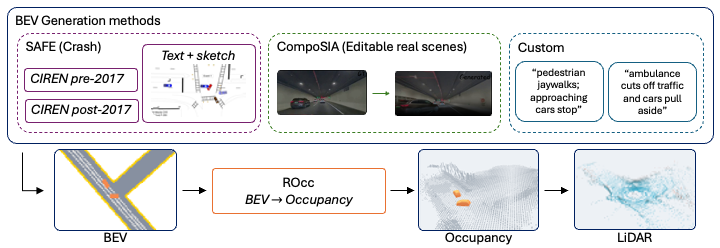
Three authoring front-ends produce an ego-centric BEV layout, decoded to 3D occupancy and LiDAR.

Figure 1. Crash-grounded controllable generation. Three authoring front-ends — editable custom scenes, crash reconstructions, and curated text — produce an ego-centric bird's-eye-view layout, which an occupancy DiT turns into 3D semantic occupancy and, in turn, LiDAR.

Three authoring front-ends

Custom (LLM)

Natural-language prompts drive a traffic simulator that emits the BEV layout — full control over agents, maneuvers, and road type.

SAFE

Reconstructs real crash reports into vehicle trajectories, recovering long-tail collision geometry from structured accident descriptions.

CompoSIA

Edits real recorded scenes (cut-ins, lane changes) on the true map, warping agents while keeping the surrounding world consistent.

BEV → Occupancy → LiDAR

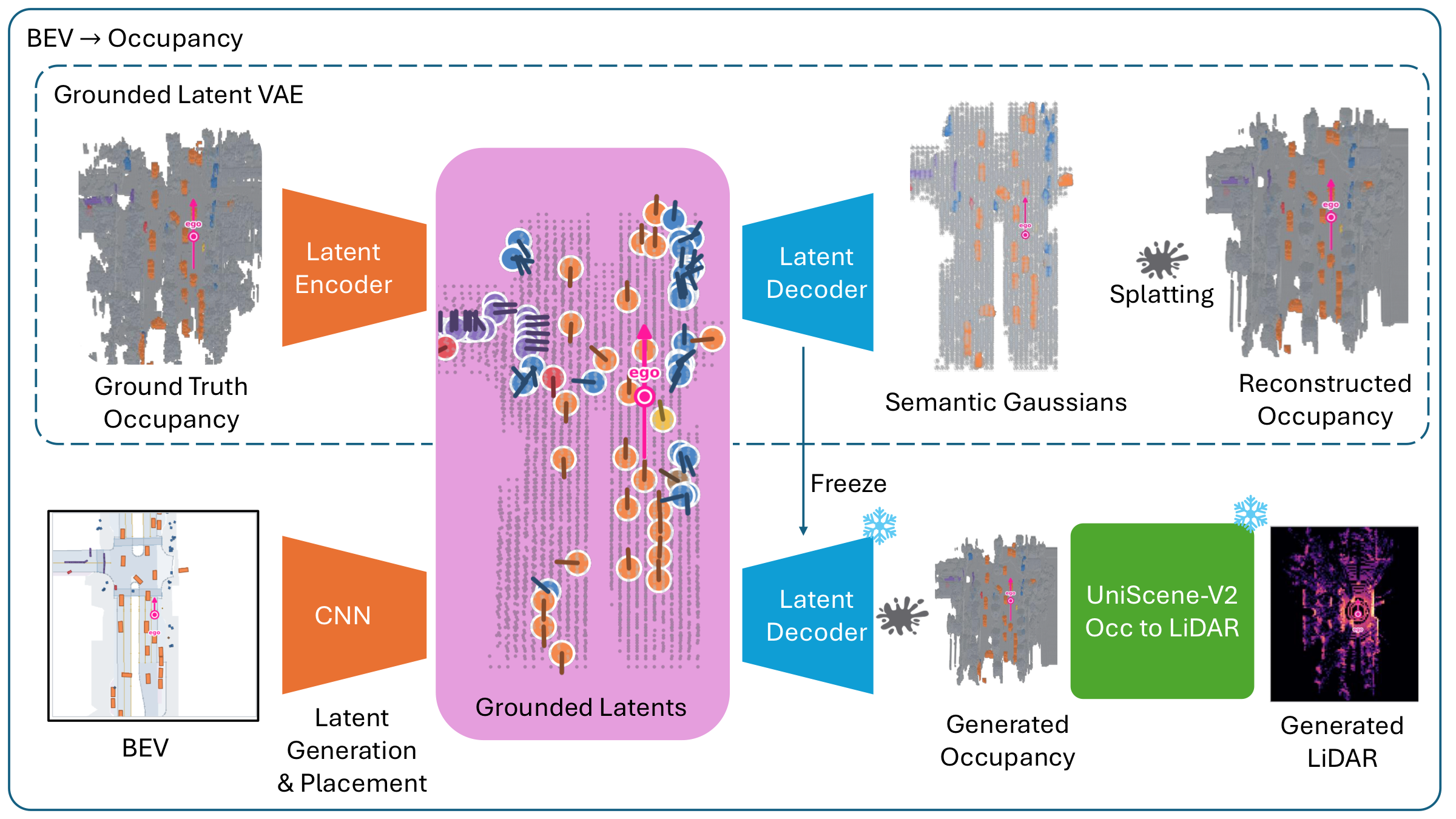
A grounded latent VAE encodes occupancy to grounded latents; a CNN generates latents from a BEV layout, decoded to occupancy and LiDAR.

Figure 2. A grounded latent VAE (top) encodes ground-truth occupancy into grounded latents decoded via semantic Gaussians. At generation time (bottom) a CNN maps a BEV layout to those latents, which the frozen decoder turns into occupancy, and an occupancy-to-LiDAR model into a point cloud.

The interactive demo shows 22 curated scenarios across the three front-ends, each as input → 2D BEV motion → 4D occupancy → 4D LiDAR (occupancy is a 200×200×16 voxel grid, per-frame dynamics, each frame decoded independently; LiDAR is rendered as an interactive point cloud). Custom scenes add a World-frame / Ego-centric view toggle.